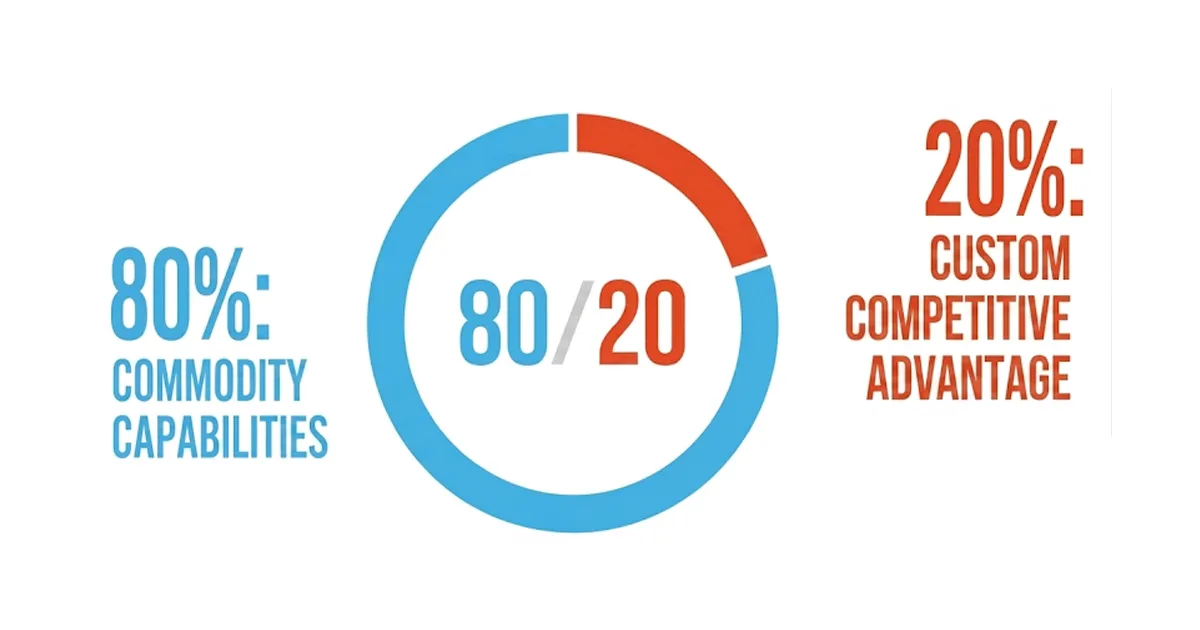
Most of your stack’s competitive value lives in 20% of its capabilities — the ones specific to how your business wins. But implementation energy flows to the commodity 80% because surfacing the differentiating 20% takes diagnostic work and investment most organizations won’t commit to.
Key Takeaways
- 80% of your stack's competitive value lives in the 20% of capabilities unique to your business.
- Organizations default to commodity features because differentiation demands honest assessment and real investment.
- You can hypothesize about your differentiating 20% before go-live, but you can only prove it after.
- Post-launch diagnostic work costs time, people, and budget. Skipping it guarantees you never reach the 20%.
The Pareto Principle shows up everywhere in business: 80% of outcomes tend to come from 20% of inputs. In martech, that ratio plays out in a way most organizations don’t recognize until they’re stuck with the consequences.
Look at your stack. The part that handles email delivery, form capture, lead scoring, basic segmentation, CRM sync, and reporting dashboards? That’s the commodity 80%. Every competitor in your space has those same capabilities. They’re table stakes. They qualify you to play.
The other 20% is where your competitive advantage lives. Your particular customer journey orchestration. The data model that reflects your actual buying process. The integration logic that connects your specific operational reality. Most of your stack’s business value sits inside that 20% of capabilities. And most organizations barely touch it.
That’s the Pareto trap in martech. Organizations invest the bulk of their implementation energy into the capabilities that deliver the least competitive value, while the capabilities that could differentiate them go unbuilt, unfunded, and unrecognized until it’s expensive to fix.
Why the 80% Gets All the Attention
Two reasons keep organizations stuck in the commodity layer.
First, every procurement tool is built to evaluate the 80%. Vendor demos showcase standard features. RFP matrices compare commodity capabilities across platforms. Feature checklists rank tools by the things everyone already does. Nothing in that process surfaces the capabilities specific to how your business wins customers. The 20% doesn’t show up in a demo. It lives in your operational reality, and no vendor knows what that looks like better than you do.
Second, surfacing the 20% is expensive work. You have to examine your own data honestly enough to find where the gaps are. Audit your budget to see where investment actually goes versus where strategy says it goes. Assess your team’s actual capability against what you’ve told the board they can do. That takes real time, real people, and real money. It also takes a kind of organizational honesty that makes people uncomfortable, because it points at decisions already made and money already spent. Most organizations would rather buy another platform.
The result is predictable. 85% of marketing teams spend more than half their time fixing problems rather than creating new programs (1. DemandScience, 2025). Data cleanup. Fixing broken integrations. Campaign troubleshooting. Commodity maintenance. The operational energy that should go toward building differentiation gets consumed by keeping the 80% running. And because the work feels productive, nobody questions whether it’s aimed at the right layer of the stack.
The conventional pushback is better upfront planning. More thorough discovery workshops. More detailed requirements documents. That sounds right, but it misses the core problem. Planning can only work with what’s known before go-live. The differentiating 20% resists specification because it depends on operational conditions that don’t exist until the system is live. No discovery workshop surfaces what your customers will actually do when they interact with your stack under real conditions.
The Prove-It Problem
You can hypothesize about your differentiating 20% before go-live. Strategy workshops, competitive analysis, and customer journey mapping all give you informed guesses. Some of those guesses will be right. But you can’t prove which ones hold up until live operations generate live data. Real customers interacting with real systems under real conditions is the only test that counts.
Most organizations don’t plan for the timing gap. The hypotheses about your 20% arrive before go-live. The proof arrives after. And the gap between hypothesis and proof is where the investment has to happen: post-launch configuration, training, governance, measurement infrastructure. The work that turns a guess into a validated capability. Almost nobody budgets for it.
The window to act on what you learn is also narrowing. CRM replacement rates dropped from 22.1% to 9.7% in a single year (2. Third Door Media, 2026). Stacks are getting stickier across every major category. Once you’ve locked into your commodity 80%, the cost of adapting the foundation to accommodate the 20% goes up every quarter you wait.
Meanwhile, most organizations can’t connect their technology spending to business outcomes at all. McKinsey found that none of the 50-plus senior marketing leaders they interviewed could clearly articulate the return on their martech investments (3. McKinsey & Company, 2025). They track email sends, open rates, and impressions. Those are 80% metrics, output from the commodity layer. The 20% that drives competitive value doesn’t have a dashboard because nobody built the measurement infrastructure to track it.
The organizations that get this right build diagnostic discipline into their operations after launch. They budget for post-go-live configuration, training, and governance as permanent line items, not project afterthoughts. And they treat the foundation as something that has to evolve, because the 20% surfaces on its own schedule, not yours.
One question tells you where you stand. Look at your stack and ask how much of your implementation budget went to capabilities only your business needs. If the honest answer is “not much,” you’ve found where the value gap lives.
Frequently Asked Questions
What is the 80/20 rule in martech?
Why do organizations focus on commodity martech capabilities?
Can you plan for the differentiating 20% before implementation?
How do sticky martech stacks affect the 80/20 problem?
How do I know if my organization is stuck in the Pareto trap?
References
- DemandScience. (2025). 2026 State of Performance Marketing: Exposing the Marketing Data Mirage. DemandScience. https://demandscience.com/resources/the-2026-marketing-data-mirage-report/
- Third Door Media. (2026). MarTech Replacement Survey 2025. MarTech. https://martech.org/wp-content/uploads/2026/03/MT_replacement_survey_2025_031126.pdf
- McKinsey & Company. (2025). Rewiring martech: From cost center to growth engine. McKinsey & Company. https://www.mckinsey.com/capabilities/growth-marketing-and-sales/our-insights/rewiring-martech-from-cost-center-to-growth-engine